Chair of the Manhiça Foundation Board Calls for Greater Investment in Scientific Research

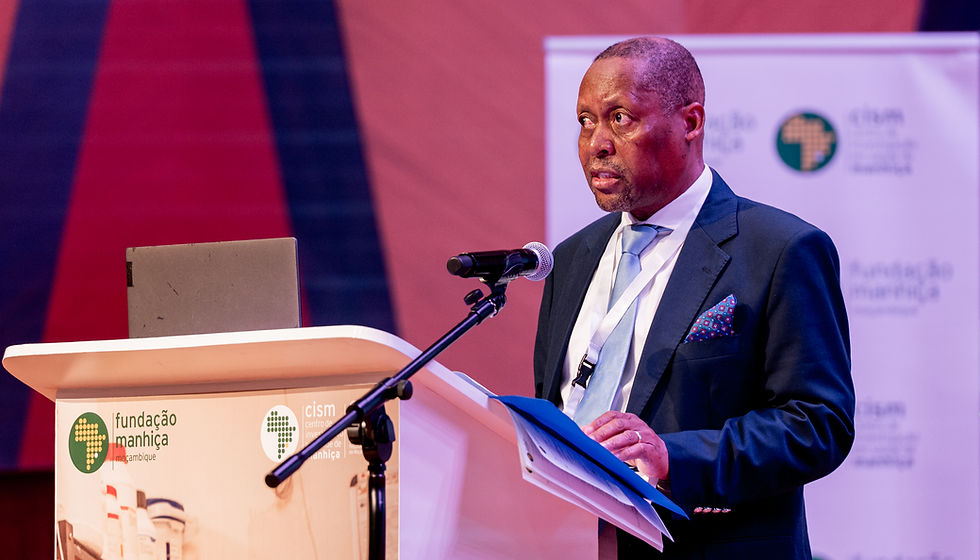
The Chair of the Manhiça Foundation Board, Martinho Dgedge, has called for greater investment in scientific research, stronger national research institutions, and enhanced international cooperation as essential pillars for addressing emerging global health threats. He made these remarks during the opening of the 5th Manhiça Foundation Global Health Symposium, held on 16 July in Maputo as part of the celebrations marking the 30th anniversary of the Manhiça Health Research Centre (CISM).
Addressing an audience of researchers, health professionals, policymakers, students, and national and international partners, Dgedge highlighted the increasingly critical role of science in preventing, monitoring, and responding to diseases affecting both Mozambique and the wider world. He noted that research conducted in Mozambique has helped shape public policies, supported the introduction of new health interventions, and strengthened the National Health System's capacity to respond to public health challenges.
In his address, Dgedge stressed that today's context—characterised by climate change, antimicrobial resistance, emerging and re-emerging diseases, and the persistent risk of new pandemics—demands a renewed commitment to scientific knowledge generation. He therefore advocated for stronger national research capacity, sustained investment in human resource development, and closer collaboration among research institutions, universities, government, and development partners to ensure that scientific evidence continues to inform decision-making and improve population health.
These challenges were also the focus of the symposium's first panel discussion, entitled "Scientific Leadership, Financing and Global Cooperation in the Face of Emerging Threats," one of the event's central sessions. Co-chaired by Pedro Alonso, Founding Scientific Director of CISM and former Director of the Global Malaria Programme at the World Health Organization, and Eduardo Samo Gudo, Director General of the National Institute of Health, the panel brought together international experts who called for a new vision for scientific development in Africa, built on local leadership, sustainable financing, and more equitable partnerships.
Global Health Challenges Require Responses Led by African Countries

During the discussion, panellists agreed that global health challenges require responses led by African countries themselves, with greater capacity to set priorities, generate evidence, and translate knowledge into public policy. They argued that the continent has the researchers, institutions, and accumulated experience needed to take on a more prominent role, provided that conditions are created to strengthen national research systems and secure long-term investment.
Yap Boum II, Deputy Director General of the Africa Centres for Disease Control and Prevention (Africa CDC), argued that Africa must invest in building strong scientific institutions and supporting its researchers, while progressively reducing its dependence on external funding. According to Boum II, the continent needs to produce knowledge that responds to its own priorities and transform research into a driver of development and preparedness for future health crises. Along the same lines, Thomas Nyirenda, Executive Director of the Global Health EDCTP3 Joint Undertaking, emphasised that strengthening research in Africa depends on establishing predictable and sustainable financing mechanisms capable of supporting not only individual research projects but also institutional growth and the training of future generations of scientists.
Boum II also called for closer collaboration among governments, research institutions, and funding organisations to ensure that scientific research addresses the priorities of African countries. Meanwhile, Àngel Font, Corporate Director for Research and Health at the "la Caixa" Foundation, stressed that philanthropy should serve as a catalyst for scientific innovation, complementing—but never replacing—public investment in research. He further argued that international partnerships should be built on trust, knowledge sharing, and the joint development of solutions to common challenges.
The panellists also agreed on the need to accelerate the adoption of new technologies, including artificial intelligence and digital epidemiological surveillance systems, strengthen scientific collaboration networks, and create more opportunities for early-career researchers to assume leadership roles. They concluded that strengthening African science will be essential to enhancing the continent's capacity to respond to future public health emergencies and contribute to global health solutions.
Strengthening Science in Africa Also Depends on Creating Opportunities

Another highlight of the symposium was the second panel discussion, entitled "Three Decades of Training Scientific Leaders for Africa." Participants argued that strengthening science across the continent depends not only on sustained investment in research but also on creating opportunities for a new generation of scientists to take on leadership roles and contribute to addressing public health challenges. Speaking during the session, Francisco Saúte, Director General of CISM, emphasised that investing in people has been one of the institution's defining pillars throughout its 30-year history.
According to Saúte, CISM's legacy is measured not only by its scientific output but also by the researchers, health professionals, and leaders it has helped train, many of whom are now contributing to strengthening health systems and research capacity in Mozambique and across Africa. The panel also featured Quique Bassat, Director General of the Barcelona Institute for Global Health (ISGlobal); Eusébio Macete, former Director General of CISM and current Rector of UniLúrio University; Khátia Munguambe, former Head of CISM's Population Studies Area and currently Human Development Adviser at the British High Commission; and Fabíola Fernandes, Director of the Pathology Department at Maputo Central Hospital.
In addition to the two panel discussions, the 5th Manhiça Foundation Global Health Symposium featured four scientific sessions dedicated to CISM's main research areas. National and international researchers presented the latest scientific advances in malaria, maternal and child health, tuberculosis, and bacterial, viral, and other neglected tropical diseases, fostering dialogue between science, clinical practice, and public policy.
Symposium Recognises Outstanding Scientific Posters
The symposium also featured an awards ceremony recognising the best scientific posters presented during the event. Anete Mendes received first prize for her study, "Determinants of Viral Load and Its Impact on Adverse Pregnancy Outcomes in African Women Living with HIV." The second prize was awarded to Arlindo Chidimatembue for "Genomic Surveillance of Malaria in Southern Mozambique: Parasite Importation, Genetic Connectivity, and Outbreak Investigation." Third place went to Ariel Nhacolo for "Who Fathers Pregnancies Among Adolescents in Manhiça District? A Socio-Demographic Profile of the Partners of Adolescent Mothers, 1998–2021."
Video: Highlights of the 5th Manhiça Foundation Global Health Symposium